



How To Optimise Your Content For AI In Search

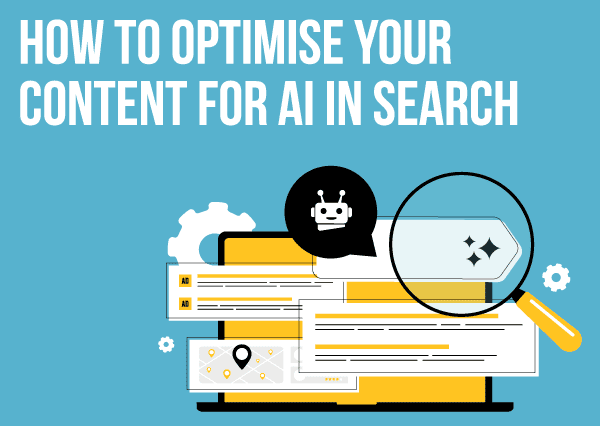
When it comes to SEO, standing still is never an option. Search is constantly evolving, and right now, AI is leading the charge. From AI overviews to more conversational, multi-step queries, the way users interact with Google looks very different to how it did even a year ago.
You might already be creating great content, ranking well, and ticking all the traditional SEO boxes, yet still feel like visibility is harder to come by. That’s because AI-powered search isn’t just about where you rank anymore; it’s about how your content is understood, summarised, and surfaced by Google’s AI systems.
That being said, optimising for AI in search doesn’t mean throwing out everything you know about SEO. It simply means refining it. If you’ve been wondering what you need to do to start appearing, here are a few things that will help!
Focus on people-first content
It’s tempting to think you need to write specifically for AI, but that’s not the case. Google’s AI systems are designed to surface content that helps users, so your priority should always be the person on the other side of the screen.
Ask yourself:
- Does this content genuinely answer the question being asked?
- Is it written in a clear, natural way?
- Does it offer something beyond what’s already out there?
Content that solves problems, explains topics clearly, or provides expert insight is far more likely to be featured in AI overviews. Thin, generic pages that say very little won’t stand out. Depth, originality, and clarity are what help your content earn its place.
Match intent, not just keywords
Traditional SEO used to revolve around keywords, but AI-driven search is far more focused on intent. That means understanding why someone is searching, not just what words they’re using.
Are they:
- Looking for a quick definition?
- Researching a topic in more detail?
- Comparing options before making a decision?
Your content should reflect that intent. A short, surface-level answer won’t satisfy a user who’s researching, while a long, detailed guide might overwhelm someone looking for a quick explanation. Matching the depth and format of your content to user intent makes it far more effective in AI search.


Structure your content clearly
You could have the most helpful content in the world, but if it’s difficult to read, it’s going to struggle. That’s true for users, and it’s just as true for AI. AI relies heavily on structure to understand what your page is about and which parts are most important. That’s why clear formatting really matters.
Use:
- Headings that clearly describe what each section covers
- Short paragraphs that get to the point
- Bullet points or lists, where they help break things up
This makes your content easier to scan, which users appreciate, and it also makes it easier for AI to pull out key information when generating summaries or overviews. If someone can quickly understand your page at a glance, AI probably can too.
Match intent, not just keywords
Keywords haven’t disappeared, but when optimising for AI, they’re not the main focus. AI-driven search is much more about intent, meaning what the user is actually trying to achieve with their search.
Someone searching “what is AI search” wants a very different type of content from someone searching “how to optimise content for AI search”. One is looking for a simple explanation, the other is looking for guidance.
Your content should reflect that. Think about:
- What stage of the journey the user is at
- How much detail they’re likely to want
- Whether they’re researching, comparing, or ready to take action
When your content matches intent properly, it’s more likely to be surfaced in AI results, and users are more likely to trust and engage with it once they see it.
Use structured data properly
Structured data, or schema markup, helps search engines understand your content more clearly. It gives Google extra context about what’s on your page, which can improve how your content appears in rich results, featured snippets, and AI-generated summaries.
That said, it’s not something to use blindly. Any structured data you add should always match what’s visible on the page. Trying to mark up content that isn’t actually there, or overdoing it, can cause more harm than good.
Think of structured data as a supporting tool. When your content is already strong and well-written, schema helps reinforce that and makes it easier for AI to interpret it correctly.


Strengthen E-E-A-T
We’ve said it before, and we’ll say it again. Experience, Expertise, Authoritativeness, and Trustworthiness (E-E-A-T) play a huge role in how Google evaluates content, especially when AI is deciding what to surface and summarise.
To strengthen E-E-A-T, focus on:
- Keeping your content accurate and up to date
- Demonstrating real knowledge and experience in your writing
- Using credible sources where relevant
Content that’s clearly written by people who know what they’re talking about is more likely to be trusted by Google and by users. Over time, this helps build authority around your site and increases the chances of your content appearing in prominent search features.
Think beyond just text
Search isn’t just about text anymore. AI-powered search is increasingly multimodal, which means images and videos play a much bigger role in how content is understood and presented.
Supporting your written content with:
- Quality images
- Simple diagrams or visuals
- Relevant videos
Can help bring your content to life and improve how it performs in search, particularly for more complex topics. It also improves the overall user experience, which is something Google continues to prioritise as search evolves.
Don’t obsess over clicks
With AI answering more questions directly in search results, not every user will click through straight away, and that’s okay. Visibility still matters. Appearing in AI overviews helps build familiarity and trust, especially for users who are still in the research phase. When they’re ready to take the next step, they’re far more likely to turn to a brand they already recognise. Instead of focusing solely on traffic numbers, look at the quality of visits you’re getting and the role search plays in the wider customer journey.
With AI answering more questions directly in search results, not every user will click through straight away, and that’s okay. Visibility still matters.
Appearing in AI overviews helps build familiarity and trust, especially for users who are still in the research phase. When they’re ready to take the next step, they’re far more likely to turn to a brand they already recognise. Instead of focusing solely on traffic numbers, look at the quality of visits you’re getting and the role search plays in the wider customer journey.
At 21Digital, we specialise in lead generation and e-commerce, delivering results-driven services like web design, web development, SEO, Google Ads, digital consultancy, social media marketing, and email marketing, and more. So, if you’re looking for a team that’s as dedicated to your success as you are, get in touch – we’d love to help you make a difference!